מסורת התורה

OUR MESORAH

Linking the Chain of Our Heritage

A transformative sefer by

Rabbi Sholom Schochet

A Foundational Question · An Extraordinary Answer

Are the words and letters of our Sefer Torah
identical to those given by Moshe Rabbeinu?
וְזֹאת הַתּוֹרָה — V'zos HaTorah, This is the Torah
Discover Surprising Answers to Profound Questions

For thousands of years the Jewish people have guarded the words of the Torah with reverence and precision. Our Mesorah reveals the remarkable story of how that chain endured.

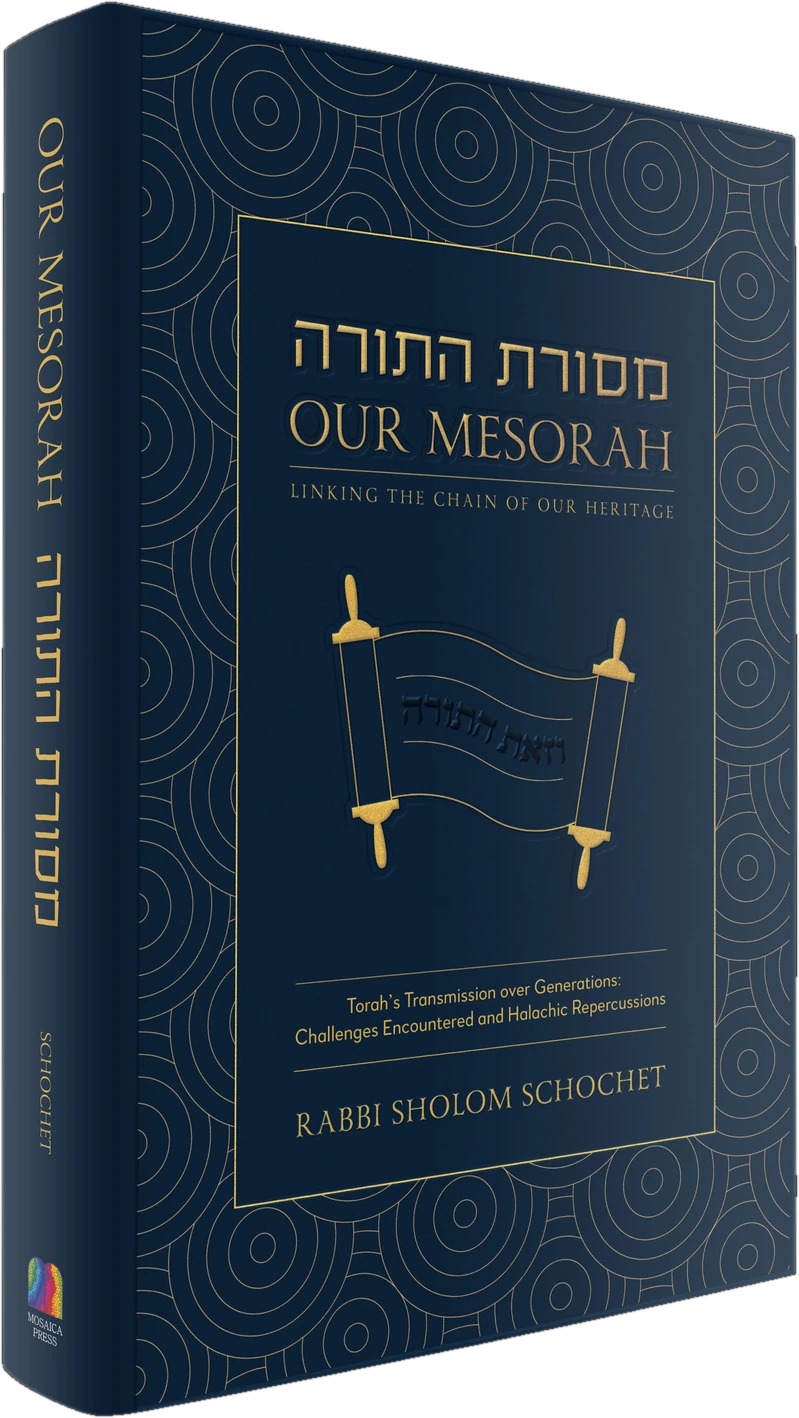
Our Mesorah by Rabbi Sholom Schochet — hardcover edition

A groundbreaking exploration of the Torah's transmission across millennia

Drawing exclusively from Torah sources, Gemara, Midrashim, Rishonim, Acharonim, and Poskim, Our Mesorah traces the sacred chain of Torah transmission from Moshe Rabbeinu to the present day, illuminating periods of uncertainty, the meticulous efforts to restore textual precision, and the profound halachic consequences.

This sefer confronts the most challenging questions head-on, presenting them with scholarly rigor and resolving them with clarity and reverence. It will forever transform how you behold the Sefer Torah when declaring:

וְזֹאת הַתּוֹרָה
THIS IS THE TORAH
MOSHE GAVE US.

Our Mesorah is more than a historical or academic study; it is a heartfelt tribute to the resilience and dedication of the Jewish People. It invites readers to appreciate the Divine orchestration that has preserved the Torah through centuries of exile and upheaval, and to honor the legacy of those who have devoted their lives to its transmission.

This book takes you on an intellectual expedition — traversing Jewish history, spanning the globe, and encountering the greatest personalities of Judaism.

Written for Every Link in the Chain

The Thoughtful Learner

You hear the Torah read every Shabbos and declare "V'zos HaTorah." This sefer will transform that moment — giving you a profound understanding of the chain of transmission behind every letter you are beholding.

The Talmid Chacham

Rigorous analysis spanning Gemara, Rishonim, and Acharonim — from the Rambam's reliance on the Ben-Asher Codex to the Rashba's halachic mechanisms, the Avnei Nezer's bold assertion, and the Mechaber-Rama dispute. Every source cited in full, in the original.

The Sofer

Understand the halachic foundations of every letter you inscribe — why our mesorah follows the Rameh's Masores S'yag L'Torah, the history behind variant spellings like totafos and daka, and what makes a Sefer Torah kosher across different traditions.

The Kiruv Rabbi & Rediscovering Jew

For those guiding Jews back to their heritage — and for those on the journey themselves. In an age when a single search can surface distorted quotes from the Gemara, this sefer equips you to "Know what to answer," confronting the hardest sources head-on and resolving them with clarity and reverence.

The Parent & Mechanech

Strengthen emunah in the next generation with the full story of how our mesorah survived exile, persecution, and dispersion — and emerged with only two disputed letters in the entire Torah; a testament to the miracle of our heritage.

The Baal Korei

You stand before the tzibbur each Shabbos and give voice to the Torah's words. This sefer deepens your appreciation of the nekudos you vocalize, the taamim you sing, the k'ri and k'siv you navigate — and the halachos that govern what happens when an error is found mid-leining.

Whether you are new to the topic or have learned it for years,
this sefer meets you where you are — and takes you further.

Words of Praise

Endorsed by leading rabbonim worldwide.

Featured Haskama

Free Preview Chapter

Chapter 2, page 1 Chapter 2, page 2 Chapter 2, page 3 Chapter 2, page 4 Chapter 2, page 5 Chapter 2, page 6
Page 1 / 6 100%

Purchase Our Mesorah

A sefer that will forever transform how you behold the Torah

592 pages of rigorous scholarship drawn exclusively from Torah sources. Includes the complete Matan Torah supplement, historical timeline, appendices, and more.

Author Rabbi Sholom Schochet
Publisher Mosaica Press
Distributor Feldheim
Pages 592
ISBN 979-8-89767-024-6
Our Mesorah by Rabbi Sholom Schochet — hardcover edition

Explore the Sefer

10 Parts
·
48 Chapters
5 Appendices
·
1 Supplement

A carefully structured journey through the Torah's transmission, from Sinai to the present day.

TABLE OF CONTENTS
Select a part, appendix, or supplement to view chapters
Chapter 1Our Love of Torah
"There is no love like the love of Torah." — Avos D'Rabi Nosson
From the Gemara's portrayal of Torah as a betrothed bride to David Hamelech's declaration that it surpasses gold and honey, the Jewish nation's love for Torah is unparalleled — and it is precisely this deep veneration that compels us to confront the challenging question ahead.
Chapter 2"This Is the Torah" — The Central Question
"The books of the Torah are found to be inconsistent only in a few places." — Rabbeinu Yonah
The sefer's foundational question — "Are the words and letters of our Sefer Torah identical to those given by Moshe Rabbeinu?" — is introduced alongside the Sefer Ha'Ikarim's emphatic affirmation and Rabbeinu Yonah's candid acknowledgment of inconsistencies, revealing this question's enduring halachic weight.
Chapter 3In Defense of Torah
"The order of our holy Torah, its words, and its letters are counted, refined, and hewn from a sacred and awe-inspiring source." — Ohr Hachaim
Invoking the Mishnah's mandate to "know what to answer," this chapter deliberately assembles seemingly alarming passages from the Gemara, Rishonim, and Acharonim — passages that could appear to undermine our mesorah. Their resolution will unfold across the chapters ahead.
Chapter 4A Synopsis of This Sefer
"Mesorah serves as a protective fence for the Torah." — Pirkei Avos
A roadmap of the intellectual journey ahead: from Torah's immutability through eras of challenge and uncertainty, the restoration efforts of the baalei mesorah and Rishonim, the halachic ramifications that persist to this day, and ultimately a nuanced answer grounded in historical effort, halachic consensus, and Divine providence.
Chapter 5Torah's Immutability
"The concept of addition and subtraction applies to the words of human beings. But in the words of the living G-d, addition and subtraction do not apply." — Maharal
Anchored in the Maharal's philosophy, the Rambam's Eighth and Ninth Principles of Faith, and the Gemara in Sanhedrin, this chapter affirms that the Torah is entirely from Hashem, eternally unchanged, and that attributing even a single pasuk to human authorship constitutes denial of its Divine origin.
Chapter 6Torah's Words and Letters
"If you omit the aleph, you destroy the world." — Rashi
Rabbi Yishmael's warning to a sofer that missing or adding even one letter can "destroy the entire world" is brought to life through vivid examples from the Midrash, Rashi, and Tosafos, demonstrating that the Torah's meaning and sanctity hinge on the precision of every single letter.
Chapter 7Beyond the Letters
"The letters are likened to the body, and the nekudos to the soul." — Rabbeinu Bachya
The Torah's precision extends beyond its consonantal text to encompass kotzim (crowns), nekudos (vowels), and taamim (cantillation marks) — all Divinely mandated and consequential. If even these subtle elements matter, how much more so every letter of the text itself.
Chapter 8The Added Dots
"All the words in the Torah that have dots above them were doubtful in the hands of Ezra Hasofer." — Chizkuni
The Chizkuni, Daas Zekeinim MiBaalei Tosafos, Avos D'Rabi Nosson, and others describe how Ezra Hasofer placed dots above certain words as markers of unresolved doubt, intending to seek clarification from Moshe Rabbeinu — with halachic ramifications codified by the Taz.
Chapter 9Tefillin's Compartments
"I was startled to see great confusion among the most brilliant sages of the world regarding the word totafos." — Minchas Shai
The Gemara derives tefillin's four compartments from the precise spelling of totafos, yet our Sifrei Torah contain a spelling that contradicts this derivation. The Minchas Shai documents four conflicting opinions among the Rishonim, and the Torah Temimah declares the discrepancy "a great wonder."
Chapter 10An Astonishing Rashi
"In Rashi's Sefer Torah it was written with a vav according to his tradition of the mesorah." — Sifsei Chachamim
Rashi's commentary on Parashas Terumah identifies a redundant vav entirely absent from our Torah scrolls. The Mizrachi, Minchas Shai, and Sefer Hazikaron all confirm Rashi's Sefer Torah contained this extra letter — raising questions about whose text more faithfully reflects the original.
Chapter 11The "Petzua Dakah" Controversy
"I have become exhausted and distressed trying to determine if the word dakah is spelled with an aleph or a hei." — Minchas Shai
The Minchas Shai's lament reveals a centuries-old dispute dividing Ashkenazic, Sephardic, Chabad, and Yemenite communities to this very day, traced through the Baal Hatanya and the Minchas Chinuch to older Ashkenazic customs.
Chapter 12The Sons of Eli — Pinchas and Chofni
"Our Gemara disagrees with our sefarim!" — Tosafos
A discrepancy between the Gemara's reading of a word in Tanach and our scrolls prompted Rashi to call the Talmudic reading a "great error" and Tosafos to admit that tensions exist between the mesorah of Chazal and our tradition.
Chapter 13Additional Discrepancies
"The following clarifications may have significant implications … Therefore, I have recorded this matter for preservation." — Haflaah She'ba'arachin
Rabbi Akiva Eiger's Gilyon HaShas catalogs instances where the Gemara's text of pesukim differs from our Sifrei Torah. Supplemented by the Haflaah She'ba'arachin and the Darkei Hashinuyim, these compilations force a reckoning with the scope of textual variation across the generations.
Chapter 14Origins of Mesorah
"Thus, there were forty generations from Rav Ashi back to Moshe, our teacher, of blessed memory." — Rambam
Beginning with Pirkei Avos and tracing forty unbroken generations through the Rambam's chain of transmission from Moshe to Rav Ashi, the sacred continuity of masores haTorah is established — yet a closer examination reveals pivotal moments when its links were strained.
Chapter 15"We Are Not Experts"
"They were experts in the missing and extra letters; we are not." — Kiddushin
Earlier generations counted every letter and identified the Torah's precise midpoints, yet the Amoraim conceded "We are not experts" — an acknowledgment so consequential that it reverberates through every halachic discussion of mesorah that follows.
Chapter 16Pesukim Count
"In that Sefer Torah they found in Yerushalayim, the script and the number of pesukim were different." — Rav Hai Gaon
The Gemara's assertion that Tehillim contains more pesukim than the Torah — when it actually has far fewer — is so astounding that Tosafos calls it "a great wonder," revealing that even pasuk division was subject to uncertainty during the Amoraic era.
Chapter 17Moshe Rabbeinu's Thirteenth Sefer Torah
"Moshe wrote thirteen Sifrei Torah: twelve for the twelve Shevatim, and one he placed in the Aron." — Devarim Rabbah
On the final day of his life, Moshe wrote thirteen Sifrei Torah, with the thirteenth placed beside the Aron as the authoritative master copy. The Rogatchover Gaon suggests it even included taamim, nekudos, and k'ri and k'siv notations — yet its eventual loss would shape masores haTorah for all generations.
Chapter 18The Tumultuous Periods of Bayis Rishon
"I have found the Sefer Torah!" — Melachim II
During the era of the first Beis Hamikdash, wicked kings suppressed Torah study so thoroughly that Moshe Rabbeinu's Sefer Torah had to be hidden. Its rediscovery became an unexpected national event of mourning, only to be concealed once more as the threat of invasion loomed.
Chapter 19The Fate of Moshe Rabbeinu's Sefer Torah
"The Aron was hidden in its place." — Yoma
Where is Moshe's master Sefer Torah today? This chapter examines the Rambam's account that King Yoshiyahu concealed the Aron in chambers built by Shlomo Hamelech, alongside dissenting views that it was exiled to Bavel — with a surprising possibility that the Sefer Torah was destroyed.
Chapter 20Ezra HaSofer and the Anshei K'nesses Hagedolah
"Ezra was suitable for the Torah to be given by him to the Jewish People, had Moshe not come first." — Sanhedrin
Returning from seventy years of Babylonian exile, Ezra Hasofer — navi, Kohen Gadol, and master scribe — assembled the 120 scholars of the Anshei K'nesses Hagedolah and wrote a new master Sefer Torah, restoring masores haTorah from the brink of oblivion.
Chapter 21The K'ri and K'siv Debate
"The vocalization of the scribes, and the ornamentation of the scribes … are all halachah transmitted to Moshe from Sinai." — Nedarim
Words written one way but read another permeate the Torah and yield significant halachic implications. The Gemara attributes all k'ri and k'siv to Moshe from Sinai, yet the Radak, Meiri, and Maaseh Ephod suggest Ezra introduced them to resolve textual uncertainties.
Chapter 22Updating Scripts — Kesav Ivri and Ashuris
"The Torah was initially given in Kesav Ashuris. It was then changed to Kesav Ivri when B'nei Yisrael sinned. Ezra subsequently restored it." — Sanhedrin
Was the Torah originally given in Kesav Ivri or Kesav Ashuris? The Gemara presents three opinions, with prevailing views indicating that Ezra either introduced or restored the Ashuris script. The miraculous floating letters of the Luchos serve as evidence for the Ashuris position.
Chapter 23The Fate of Ezra Hasofer's Sefer Torah
"He burned the Torah — it appears to mean the Torah scroll that was written by Ezra, which was in the Temple courtyard." — Tiferes Yisrael
The mystery of Ezra's master Sefer Torah is explored through the possibility that it was the Torah burned by the wicked Apostomus, alongside extraordinary accounts spanning generations of first-hand encounters with what may have been that very sacred scroll.
Chapter 24The "Three Sifrei Torah" Incident
"They upheld the reading of the two and nullified the one." — Yerushalmi, Taanis
When three Torah scrolls containing variant readings were discovered in the Azarah of the Beis Hamikdash, the Sages resolved each discrepancy by following the majority. This incident established a foundational halachic precedent — the use of rov to restore mesorah — that guided Torah scholars for centuries.
Chapter 25Dating the "Three Sifrei Torah" Incident
"On the eighth of Teves, the Torah was translated into Greek … and darkness came upon the world for three days." — Megillas Taanis
By connecting the incident to the forced Greek translation under King Ptolemy, the Yefeh Mar'eh places the discovery during the latter era of the second Beis Hamikdash — though some Rishonim attribute it to Ezra's own time, a difference of centuries with significant implications.
Chapter 26Revisiting Ezra Hasofer
"Ezra was a proficient scribe and an expert in the Torah of Moshe." — Sefer Ezra
Did Ezra restore the Torah with prophetic certainty, or did doubts linger? This chapter presents a spectrum: the Maharal's insistence that every detail originated from Sinai, the Baalei Tosafos's view that Ezra left unresolved questions marked by dots, and a middle path in which Ezra employed halachic principles.
Chapter 27Torah's Exile
"As the Jewish nation is, so is the Torah." — Maharal
The Maharal draws a profound parallel: just as Hashem decreed exile upon the Jewish nation, scattering them throughout the world, so too was the Torah "scattered and dispersed." The chapter traces how persecution and displacement created the conditions for textual discrepancies between scrolls.
Chapter 28Loss and Restoration
"It is unavoidable to acknowledge that there have been periods of forgetfulness of Torah." — Chavos Yair
An extraordinary pattern emerges from the Gemara: Torah was forgotten and then restored by various sages. This recurring cycle of loss and renewal, documented across multiple Talmudic passages, reveals that the resilience of masores haTorah is a defining feature of Jewish history.
Chapter 29The Ben-Asher Codex
"From Ezra and his assembly, the tradition was passed down to the sages of Tiberias." — Minchas Shai
In the generations following the Churban, the baalei mesorah of Tiberias — most prominently the Ben-Asher family — produced a meticulously vocalized and annotated codex of Tanach. This manuscript became the single most authoritative reference point for masores haTorah, relied upon by the Rambam and generations after him.
Chapter 30The Codex's Remarkable Journey
"Unfortunately, today we only have parts of the Codex, but there are many books that were copied from it." — Peninei Halachah
From its creation in tenth-century Tiberias to its ransom by Cairo's Jewish community, its centuries-long safeguarding in Aleppo's Me'arat Eliyahu, the devastating fire of December 1947, and its eventual rescue to Jerusalem in 1958 — the Codex's odyssey mirrors the Jewish People's own story of exile and devotion to Torah.
Chapter 31Machzor Vitri — "Eis La'asos"
"It is a time to act for Hashem; therefore, our texts are also considered valid." — Machzor Vitri
Living in France without access to the Ben-Asher Codex, the Machzor Vitri acknowledged the mesorah's limitations yet maintained the Sifrei Torah remain kosher, invoking the pragmatic ruling "eis la'asos laHashem" as the basis for their continued validity.
Chapter 32The Rambam — The Codex Restored Mesorah
"The scroll on which we relied is the well-known book in Egypt. I relied upon it for the Sefer Torah that I wrote." — Rambam
Confronted with "great confusion" across all the Sifrei Torah he had examined, the Rambam found clarity in the Ben-Asher Codex which had arrived in Cairo shortly before him. Declaring that "everyone relies upon" it, the Rambam used it as the foundation for his own Sefer Torah.
Chapter 33The Rashba — Mesorah Is Restored Using Guidelines
"We do not correct Sifrei Torah according to the mesorah or the Midrashic interpretations." — Rashba
Diverging from the Rambam's reliance on the Codex, the Rashba forged a halachic methodology: follow the Gemara's readings where halachos are derived, and resolve remaining doubts by applying rov — echoing the "Three Sifrei Torah" precedent.
Chapter 34The Rameh — Masores S'yag L'Torah
"I resolved to abandon the newer books and follow the older, trusted ones." — Rameh
The Rameh undertook an exhaustive examination of every letter, seeking out the oldest available scrolls and applying rov as his guiding principle — even where this diverged from Gemara-based derivations — and recorded his findings in the seminal Masores S'yag L'Torah.
Chapter 35From Rishonim to Acharonim
"The Maharam de Lonzano did remarkable work in his sefer Ohr Torah." — Chida
From Rabbi Eliyahu Bachur's Masores Hamasores to the Minchas Shai, a succession of pivotal works built upon one another to refine the Torah's text with ever-increasing precision. Their cumulative labor bridged the Rishonim and Acharonim, producing the remarkably uniform masores haTorah we possess today.
Chapter 36"We Are Experts" — Or Are We?
"In our times, we are indeed experts in deficient and plene forms, even though in the times of the Gemara, they were not." — Avnei Nezer
The Avnei Nezer advances the remarkable claim that centuries of painstaking scholarship have rendered our current mesorah more reliable than what existed in the Amoraim's era — effectively reversing the Gemara's own admission of "We are not experts."
Chapter 37Masores HaTorah — A Continuum
"For the fulfillment of the mitzvah of writing a Sefer Torah, one requires that it certainly be kosher; for the reading of the Torah, it suffices that the invalidity is not evident." — Mishneh Halachos
This chapter introduces a "mesorah continuum" stretching from profound uncertainty to absolute certainty. Where our masores haTorah falls on this spectrum underlies the major halachic debates among the poskim.
Chapter 38The "Rov" Principle
"The halachah follows the majority, and the words of the minority are mentioned so that, should a need arise, one may rely upon them." — Eiduyos
The Torah's command to "incline after the majority" is so authoritative that even a Heavenly voice is overruled by rabbinic consensus. Yet as robust as rov is, its very application to mesorah entails an acknowledgment: the minority reading, though not followed, may hold objective truth.
Chapter 39Mesorah in Every Generation
"Even if they tell you that right is left and left is right." — Rashi
Irrespective of where our certainties lie on the mesorah continuum, there is unanimous consensus that each generation's mesorah is determined by its sages — and the Torah's command of lo sasur obligates us to follow their determination, even if the sages of a later era do not compare to those of earlier generations.
Chapter 40A Mystical Perspective
"All the deficiencies and excesses over which there is disagreement, are all the words of the living G-d." — Heichal Haberachah
The Mahari of Komarno offers a mystical framework in which differing mesorah traditions each possess spiritual truth, reflecting the Torah as it is written across all heavenly academies and worlds. While halachah follows the established mesorah, the "Heavenly Torah" contains esoteric dimensions to be revealed by Mashiach.
Chapter 41Current Disputes
"'And all the days of Noach.' Our esteemed predecessors have a significant debate and extensive discussion on this phrase." — Minchas Shai
After millennia of exile, persecution, and dispersion, the Torah text maintained across all Jewish communities worldwide is almost perfectly uniform. Only two letters remain in active dispute along with one spacing question — a testament to the extraordinary work of the baalei mesorah.
Chapter 42The Miracle of Our Mesorah
"The scholars of each generation, through their tireless toil and constant diligence, managed to restore the crown to its former glory." — Chafetz Chaim
The survival of a unified Torah text — including all 5,845 pesukim, 79,976 words, and 304,805 letters — is nothing less than a miracle and an unparalleled Divine phenomenon.
Chapter 43Writing a Sefer Torah
"The mitzvah of writing a Sefer Torah is nullified in these generations." — Shaagas Aryeh
The Shaagas Aryeh argues that our inability to guarantee textual perfection effectively nullifies the obligation of writing a personal Sefer Torah, while the Minchas Chinuch and a majority of poskim maintain the mitzvah remains fully binding — each position reflecting a different assessment of where our mesorah stands.
Chapter 44Making a Berachah Before Writing a Sefer Torah
"One does not recite a berachah on the writing of a Sefer Torah, because we are not experts in the precise spelling of certain letters." — Chasam Sofer
Why do sofrim not recite a berachah before writing a Sefer Torah? The Mahari Beirav's view that it is subsumed within the morning Birchos HaTorah contrasts sharply with the Chasam Sofer's reasoning: since our Sifrei Torah may be invalid, such a berachah risks being a berachah l'vatalah.
Chapter 45Reading from a Torah with a Different Mesorah
"Regarding the Sefer Torah of the Ashkenazim, it is permissible for Sephardim to be called up to it, and likewise, it is permissible for Ashkenazim to be called up to the Sefer Torah of the Sephardim." — Kaf Hachaim
When an Ashkenazi or Sephardi is called to a Chabad or Yemenite Sefer Torah — or vice versa — may he recite a berachah over a scroll whose mesorah differs from his own? Most Acharonim permit it, reflecting deep respect for the validity of diverse, historically accredited traditions.
Chapter 46Reading from a Torah with Missing or Extra Letters
"Our Torah scrolls are not so precise so as to say that the other one would be more valid." — Rama
The Mechaber requires replacing a Sefer Torah when any error is found, while the Rama rules that for discrepancies involving only chaseiros and yeseiros one need not — a disagreement rooted in the mesorah certainty continuum.
Chapter 47Selling a Sefer Torah
"Now that in our times all our Sifrei Torah are presumed to have some disqualification, it is permitted for an individual to sell a Sefer Torah." — Ginas Veradim
The Gemara issues an ominous warning against selling a Sefer Torah, even in dire need. Yet the Ginas Veradim and others introduced leniencies on the premise that all our Sifrei Torah are presumed to contain some disqualification — an astonishing concession whose logic flows from the broader uncertainties within our masores haTorah.
Chapter 48Revisiting the Central Question
"May the Beis Hamikdash be rebuilt speedily in our days; and grant us our portion in Your Torah." — Pirkei Avos
Returning to the central question with which this sefer began: the words and letters of our Sefer Torah have been preserved with extraordinary fidelity through millennia of historical effort, halachic consensus, and Divine providence. While minuscule uncertainties remain as a component of galus, the mesorah we hold today is overwhelmingly authentic — with a nation eagerly awaiting final clarity with Mashiach.
Appendix AHistorical Timeline
A comprehensive chronological table spanning from Matan Torah to the modern era, listing the key figures, pivotal events, and landmark sefarim that shaped the course of masores haTorah across the generations.
Appendix BBen-Asher Codex: Photos
Facsimiles of the Ben-Asher Codex, the Great Shul of Aleppo before and after the Arab riots of 1947, and the Codex on display — offering a tangible connection to the mesorah's most revered manuscript.
Appendix CTikkun Sofrim
Did the Anshei K'nesses Hagedolah actually alter the Torah's wording? This appendix examines Rashi's commentary and the Midrashic sources, ultimately presenting the prevailing view that these are euphemistic expressions chosen by the Torah itself out of reverence for Hashem.
Appendix DRabbi Meir's Sefer Torah
Despite Rabbi Meir's renowned mastery as a sofer, various Midrashim record unusual phrasings in his Sefer Torah that deviate from the accepted mesorah, inviting exploration of how to understand these variations.
Appendix EAdditional Discrepancies
The complete texts of Rabbi Akiva Eiger's Gilyon HaShas and the Haflaah She'ba'arachin are reproduced in full, each cataloging extensive lists of textual discrepancies between the Gemara's citations and our Sifrei Torah.
I.Introduction
"The words of Torah should be new to you, as if they were given today." — Rashi
A partial Sefer Torah was read prior to Matan Torah, a complete Sefer Torah was given nearly four decades later, and the Luchos were not received until Yom Kippur. This introduction unpacks why the chronology of Matan Torah remains unfamiliar — from the Torah's non-linear narrative to the absence of a mitzvah to recount these events on Shavuos.
II.Prelude to Matan Torah — Rising Anticipation
"Their arrival in the wilderness of Sinai was a source of joy and a festive occasion for them, as they had longed for it ever since their departure from Egypt." — Ramban
Over five days of ascending anticipation, the nation twice proclaimed "Naaseh!" and then "Naaseh v'nishma!" — earning celestial crowns. Remarkably, Shavuos itself was observed the day before Matan Torah, when Moshe read from a partial Sefer Torah and offerings were brought on a newly built mizbeiach.
III.Morning of Matan Torah — An Unparalleled Experience
"Hashem's Presence descended upon Har Sinai, as a groom who goes out to greet his bride." — Rashi
On Shabbos, 6 Sivan, the people awoke to visible thunder, audible lightning, and a trembling mountain engulfed in fire. The blind, deaf, and mute were healed; Har Sinai was suspended above the nation; and every Jewish soul — present and future — stood witness as Hashem unveiled His throne upon the heavens.
IV.The Aseres Hadibros — Ten Eternal Statements
"All ten statements were miraculously proclaimed by Hashem in a single utterance." — Rashi
In a voice emanating from all four directions, audible in seventy languages and producing no echo, Hashem first uttered all ten statements simultaneously — encompassing all 613 mitzvos — then repeated each individually. The people heard the first two directly from Hashem before requesting Moshe relay the remaining eight.
V.The First Forty Days — Learning the Torah
"Even if one were to combine all the generations of Israel … no innovation exists that Moshe did not already know." — Ohr Hachaim
During forty days atop Har Sinai, Moshe received the entirety of Torah She'bichsav and Torah She'baal Peh — Chumash, Neviim, Kesuvim, Mishnah, Gemara, and even the principles by which future students would derive new insights. All Torah knowledge was granted to him as a Divine gift on the final day.
VI.The First Luchos — Tablets of Testimony
"The letters mem and samech in the Luchos were standing miraculously." — Shabbos
Fashioned by Hashem from flexible, heavenly sapphire and inscribed by His "finger," the two cuboid Luchos featured text visible from all sides, with letters miraculously floating in place.
VII.The Eigel Hazahav — Desert Insurrection
"If a sinner should say, 'I will not return, for I will not be accepted,' they are told, 'Go and learn from the incident of the Golden Calf.'" — Rashi
Having miscalculated Moshe's return by one day, the people fashioned the Eigel Hazahav. As Moshe descended, the Luchos' letters flew off and he shattered the tablets — an act Hashem endorsed. Rashi teaches that the entire episode was ordained to demonstrate the power of teshuvah.
VIII.The Second Forty Days — Interceding for the Nation
"And now, if You would forgive their sin — but if not, erase me from the book that You have written." — Shemos
Ascending Har Sinai for the seventh time on the 18th of Tamuz, Moshe spent forty days pleading for the nation's forgiveness. Hashem ultimately forgave, reaffirmed His exclusive covenant, granted Moshe an unprecedented revelation of Divine glory, and instructed him to carve new Luchos.
IX.The Third Forty Days — Reconciliation
"Hashem taught Moshe the thirteen Attributes of Mercy while appearing to wear a tallis." — Rosh Hashanah
On Thursday, 1 Elul, Moshe ascended Har Sinai for the eighth and final time carrying the newly carved Luchos. During these forty days, Hashem taught Moshe the thirteen Middos Harachamim, reaffirmed His covenant with the Jewish nation, and inscribed the Aseres Hadibros onto the second set of tablets.
X.The Second Luchos — Day of Atonement
"There is no finer quality than modesty!" — Rashi
On Yom Kippur, Monday, 10 Tishrei 2449, Moshe descended with the second Luchos — this time without fanfare. His face radiated with Divine light, requiring a veil except while teaching Torah. Moshe's ascent on Thursday and descent on Monday established the custom of Torah reading on those days.
XI.The Remaining Years — Teaching a Nation
"Moshe was like a scribe who was dictated to and wrote down all of the events, the stories, and the commandments." — Rambam
From Yom Kippur until the Mishkan's inauguration, Hashem communicated with Moshe from within his tent, the Ohel Moed. After the Mishkan was erected, Hashem's voice emanated from between the Keruvim — inaudible outside — and Moshe transcribed each teaching onto individual scrolls.
XII.Transmitting Torah — A Unique Methodology
"One is obligated to review each Torah lesson with a student four times." — Eiruvin
Moshe transmitted Torah through a layered system: first to Aharon, then Aharon's sons, then the elders, and finally the entire nation. After Moshe departed, each group repeated the lesson in turn, ensuring every Jew heard each teaching four times — while Yehoshua heard it seven times.
XIII.Immersing in Torah Study — A Desert Oasis
"There has never been, and there will never be, a generation of such wisdom as the generation of the wilderness." — Aruch Hashulchan
Sustained by mahn, Miriam's well, and the Ananei Hakavod, the Dor Deah — "Generation of Wisdom" — devoted nearly forty years to immersive Torah study. Of their forty-two desert journeys, only twenty spanned the middle thirty-eight years, ensuring ample time to study and internalize the Torah.
XIV.Moshe Rabbeinu's Final Day — Transition of Leadership
"When Moshe was about to pass away, he organized the Torah into a single scroll and arranged its sections in the manner they are presented to this day." — Chizkuni
On the last day of his life, Moshe compiled and wrote thirteen Sifrei Torah, placing the thirteenth in the Aron as the authoritative master copy. He placed both hands upon Yehoshua's head, transmitting wisdom and the Torah's esoteric secrets, and the final eight pesukim were written — according to one opinion — by Moshe himself, with tears.

Read the foreword by Rabbi Yitzchak Breitowitz and the full preface, available in the sefer.

Order Your Copy

Masores HaTorah, From Sinai to Today

2448 / 1313 BCE
Moshe Rabbeinu
Received the Torah at Har Sinai and wrote thirteen Sifrei Torah, twelve for the shevatim and a thirteenth master copy placed in the Aron Hakodesh as the cornerstone of masores haTorah.
2488 / 1273 BCE
Yehoshua & the Zekeinim
Yehoshua received the Torah directly from Moshe and transmitted it to the Zekeinim, who safeguarded it through the periods of the Shoftim and early monarchy.
Era of Nevi'im
The Nevi'im
The prophets preserved and transmitted the Torah through tumultuous periods, including the reigns of righteous and wicked kings, maintaining the mesorah even as the nation's spiritual level fluctuated.
3413 / 348 BCE
Ezra Hasofer & Anshei K'nesses Hagedolah
After the Babylonian exile, Ezra restored the Torah, creating a second master copy. He placed dots above words of uncertainty and established the Anshei K'nesses Hagedolah, 120 scholars who "restored the crown of Hashem."
c. 3768–3952 / 8–192 CE
The Tannaim
The Sages of the Mishnah, including Rabbi Akiva, who derived halachos from every crown on every letter, declared their proficiency regarding every letter and word in the Torah.
c. 3952–4260 / 192–500 CE
The Amoraim
Following the Churban, the Amoraim candidly acknowledged: "They were experts in missing and extra letters, but we are not." This era of Torah's "exile" necessitated future restoration efforts.
c. 4260–4798 / 500–1038 CE
Geonim & Baalei Mesorah
The Ben-Asher family in Tiberias created the authoritative codex, the Kesser Aram Tzova, restoring textual precision. The Geonim provided definitive halachic guidance, solidifying the Gemara's central place.
c. 4800–5250 / 1040–1490 CE
The Rishonim
The Rambam endorsed the Ben-Asher Codex; the Rashba established majority-based principles; the Rameh's Masores S'yag L'Torah became the cornerstone of our current mesorah; three approaches to restoration.
c. 5250–Present
Acharonim & Poskim
The Minchas Shai codified the mesorah. The Avnei Nezer declared: "In our times, we are indeed experts." Today, only two letters in the entire Torah remain in dispute, a miraculous testament to the chain's endurance.
The Future
Mashiach
Ezra awaited Moshe Rabbeinu and Eliyahu Hanavi to clarify his dots. The Vilna Gaon linked the rebuilding of the Beis Hamikdash with the Torah's complete restoration: "שֶׁיִּבָּנֶה בֵּית הַמִּקְדָּשׁ... וְתֵן חֶלְקֵנוּ בְּתוֹרָתֶךָ"

Rabbi Sholom Schochet

SS

Torah scholar, lecturer, and author

Rabbi Sholom Schochet received his semichah from Hagaon Harav Eliyahu Fischer, zt"l, Gerer rosh ha'kollel and a member of the nesius of Agudas Yisrael of America, and Hagaon Harav Faitel Levin, author of Hamafteach Hagadol. For nearly two decades, Rabbi Schochet has served in a leadership capacity within Agudas Yisrael of America's parnassah division, COPE. Holding a doctorate in business and accounting, Rabbi Schochet is also a professor of accounting and a published author in esteemed academic journals. Rabbi Schochet delivers shiurim on a range of topics in his community.

Our Mesorah emerges from years of intensive research and a deep-seated love for the Torah and its transmission. The sefer addresses a topic of vital and timeless significance, equipping readers with the knowledge to uphold and defend the Torah's integrity.

This sefer is dedicated to the generations before him and those who will follow, enduring links in the chain of our Torah and heritage.

Contact the Author

Reviews, comments, corrections & correspondence

Whether you have a comment on the sefer, a source to share, a correction to suggest, or simply wish to express your thoughts, Rabbi Schochet warmly welcomes hearing from readers.

Please use this contact form.

Send a Message

Message Sent

Thank you for reaching out. Rabbi Schochet will respond as soon as possible.

וְזֹאת הַתּוֹרָה — V'zos HaTorah

Every Shabbos, you behold the Sefer Torah and declare "V'zos HaTorah - This is the Torah."

Now, discover the extraordinary story behind those words.
Purchase the Sefer
Order Your Copy